The Prickly Pear cactus (Opuntia genus) is native to southern USA, Mexico, Central America, the Caribbean and tropical South America, this species of cactus was introduced to Australia in the 19th century for use as a natural agricultural fence and in an attempt to establish a cochineal dye industry. Because of the lack of leaves and the tough outer skin of the pads, the plant is very drought-resistant and thrived in the Australian climate. It gradually took over vast areas of land until a biological control was introduced in the form of the Cactoblastis moth following WWI.
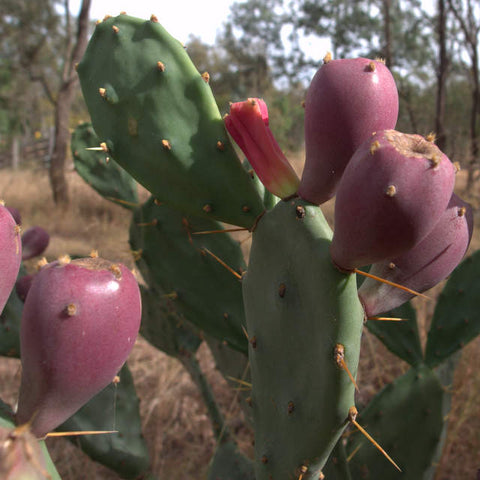
An invasive weed...
Prickly Pear is now considered an invasive weed in Australia and is found throughout Queensland, including on our property. Thankfully I often see Cactoblastis larvae on them, so they are not out of control here. Several species of Opuntia cactus are known as prickly pear, and its most likely that we have Opuntia Stricta growing here as this is the most common species in Australia. I can't be sure from reading the descriptions, as they seems similar to me, but they all produce edible fruit.
Or a source of food?
In their native lands, Opuntia fruit is harvested and eaten (even available in supermarkets), so I've been on the look out for fruit to pick since I read about it on a blog (probably this one). The pads of the cactus are also edible.

How to harvest prickly pear fruit
The main problem is the large spines and the smaller fine "stickers" on the fruit, which apparently can be very painful and difficult to remove. This excellent Youtube video shows two methods of harvesting - one for impromptu snacks using a stick and pocket knife, and the other for organised foraging trips with gloves and tongs.
Once you have the fruit harvested, you need to remove the stickers - this can be done with flame or hot water. I held mine over the gas cooktop with tongs to effectively remove the stickers.
What does prickly pear fruit taste like?
The fruit that I picked was not amazing. It tasted bland and I was scared of eating a sticker! However, now that I know that there are multiple species I wonder if there are better tasting fruit on other species (considering that this species was introduced originally to produce cochineal, not for its fruit). I am also not sure if the plant was fruiting out of season due to rain in autumn, there so the fruit may not be as sweet as spring fruit.
It is always interesting to try wild foods and learn what could be foraged on our property or nearby in an emergency situation. I wouldn't bother otherwise, as the hassle to harvest and the lack of taste are not really worth the effort.
How else can you use prickly pear fruit?
While people online are raving about the taste of raw prickly pear fruit, you can also find recipes for jams and preserves. Even the blandest fruit and vegetable tastes better with added sugar, vinegar and spices!
Being a soapmaker I was keen to find out if prickly pear can be used in soap. Indeed both the fruit pulp and the pads can be used in soap. I boiled the fruit that I harvested and strained the juice.
I used the juice in place of water in my standard soap recipe. I read that the lovely pink colour does not come through in the final soap, so I added a little red clay and some white kaolin to achieve a similar pink. A few tapioca pearls on top represent the stickers.
The use of cactus in soap is similar to aloe vera - it adds some sugars which contribute to bubbles in the soap and maybe some nutrients for the skin.
The soap is now available as a limited edition (until I see more prickly pear in fruit!). It is always fun to try new soap ingredients!

Have you tried prickly pear fruit? To eat, preserve or other applications? What do you think of it?
Comments
Post a Comment
Thanks, I appreciate all your comments, suggestions and questions, but I don't always get time to reply right away. If you need me to reply personally to a question, please leave your email address in the comment or in your profile, or email me directly on eight.acres.liz at gmail.com