Growing snake beans

One of the really fun things about our sub-tropical climate is the weird veges that we can grow.  I've written about a few them before (rosella, warrigal greens and sweet potato), and other posts about chokos and trombonchino.  Here's one more that I like to grow: the snake bean.


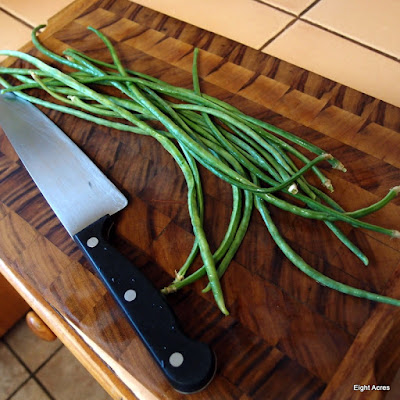
Vigna unguiculata subsp. sesquipedalis also known as yardlong bean,long-podded cowpea, asparagus bean, pea bean, or Chinese long bean.  You might have guessed from that, it is a LONG bean, up to 30cm in my experience.  Apparently sequipedalis means "one and a half feet", so it must get even longer in some conditions. It is a different genus to the common bean and more closely related to cow peas and mung beans.
Snake beans grow on vines and seem to prefer hot and wet weather, but will tolerate dry better than common beans, and will certainly produce better in the heat.  Like common beans, they do not survive frost and start to die back when overnight temperatures cool off.  The plant produces two flowers off each stem and these grow into beans, sometimes it seems like its overnight, but they can be hard to spot because at first they just look like stems and then suddenly you realise the vine is covered in beans!  They are also really hard to photograph, as you can see.  Any that get too big can be left to dry off, and used either as dried beans or seeds.


the snake bean vine

two beans starting, can you see them?

the snake been flower


I left this one too long, still good for seeds


I think they taste best when they are small, and they taste is similar to common beans.  In our climate its good to grow a few snake beans with the common beans and then depending on how summer goes, one will do better, and the common beans will keep going even when the weather cools off in autumn.  Apparently you can also eat the leaves, but I've never be short on other greens to want to try it.

Do you grow snake beans?  Do you grow any other weird vegetables?


Comments

  1. I grow them in Virginia, US where it is hot and humid. I like them because a lot of the insects that ravage the regular bush and pole beans do not eat these. They grow on poles but not as much growth as regular pole beans. The hard thing is catching the long beans before they get too ripe as they blend in with the vines so well but as you have found, they produce seed for next year. I think they taste best stir fried with a little soy sauce and garlic. They are a good choice and may produce when there is a crop failure with regular beans.

    ReplyDelete
  2. I don't know if they would grow in our Mediterranean climate here in Sth Aust Liz, but I used to buy them from the bazaar when I lived in Nepal. Fried in ghee and served with our daal and rice, delicious!

    ReplyDelete

Post a Comment

Thanks, I appreciate all your comments, suggestions and questions, but I don't always get time to reply right away. If you need me to reply personally to a question, please leave your email address in the comment or in your profile, or email me directly on eight.acres.liz at gmail.com

Popular posts from this blog

Farm update - August 2017

Its been cold this month, and very nice to have the fire going every night.  Here's a photo of my boy in his cape, great for late night woofing at things.  Most of July we were either preparing for the butcher to come or putting meat away.  Its always a big job, but its only once a year, and its all done now.  My lovely neighbour came over to help, so it was fun to have the company and work together.  Taz was a champion once again as she helped us to move cattle in the yards ready to load for the market.  Gus is not at that level yet and had to stay home (he cries when he gets left behind, but he just gets in the way and scatters the cattle).  We have had a few sprinkles of rain here and there, but also plenty of cold nights, so the grass is mostly dead and dry, waiting for the warmer weather to revive our summer-active pasture. Gus in his cape Taz after she helped to move cattle Food and cooking It was all about beef in July and we are v...

Cooking and eating beans

When I was growing up, my family never ate many dried beans, they just weren't something that was used much in NZ cuisine.  If I did eat beans, it was always from a can (and most likely baked beans).  And until recently I was still using beans from a can, but it can be difficult to get organic beans, and to find cans not lined with BPA.  Then I had an opportunity to buy some organic dry goods in bulk, so I bought 5kg of kidney beans, 5kg of adzuki beans and 5kg of chickpea (garbanzo beans).  I know, that is a lot of beans.  And then I didn't really know what to do with them!  Not just what dishes to put them in, but how to prepare them, I just didn't know what method to use. So I decided it was time to learn how to use all these beans that I bought, here's what I found out. I started with an excellent ebook called The Everything Beans Book , from Katie at Kitchen Stewardship, which has lots of bean recipes, but more importantly, an explanation of h...

Guest post: Is there a place for power tools in the garden?

One of my regular readers and commenters offered to write a guest post about a horticulture course, its quite a funny read, with some serious insights into our technology obsession.  If you'd like to submit a guest post, email me at eight.acres.liz {at} gmail.com.  While I am always happy to share links back to your blog or website, this contributor preferred to remain anonymous.  I hope you enjoy their story.... -**-  -**-  -**-  -**-  -**-  -**-  -**-  -**-  -**-  -**-  -**-  -**-  -**-  -**- Just a few days ago our daily horticulture classes were interrupted by an invitation to review some new gardening gadgets. The idea was to open half a dozen of electric hand trimmers , test them and fill in some review about their goods and bads. As nothing is more dear to a student – even a “hort “ one - to escape routine and mess around till lunchtime, we opened the boxes and got down to business. What did we...